Source: Link Testing Instruments Co.,Ltd.
QB/T 1130-1991, "Test Method for Right-Angle Tear Properties of Plastics," is a key industry standard in China for testing the right-angle tear strength of plastic films and sheets. It specifies the testing methods for these materials and is particularly suitable for quality assessment of polyethylene blown films used in agricultural greenhouses. Link Testing provides a detailed interpretation below, covering key points of the standard, operational procedures, and application scenarios:
I. Standard Classification and Scope of Application
This is a recommended standard for the light industry and remains currently valid (as of 2025); it explicitly defines the test methods for determining the right-angle tear properties of plastic films and sheets.
It applies to plastic films and sheets made of materials such as polyethylene (PE) and polypropylene (PP), and is widely used—especially in the agricultural sector—to evaluate the tear resistance of greenhouse films.
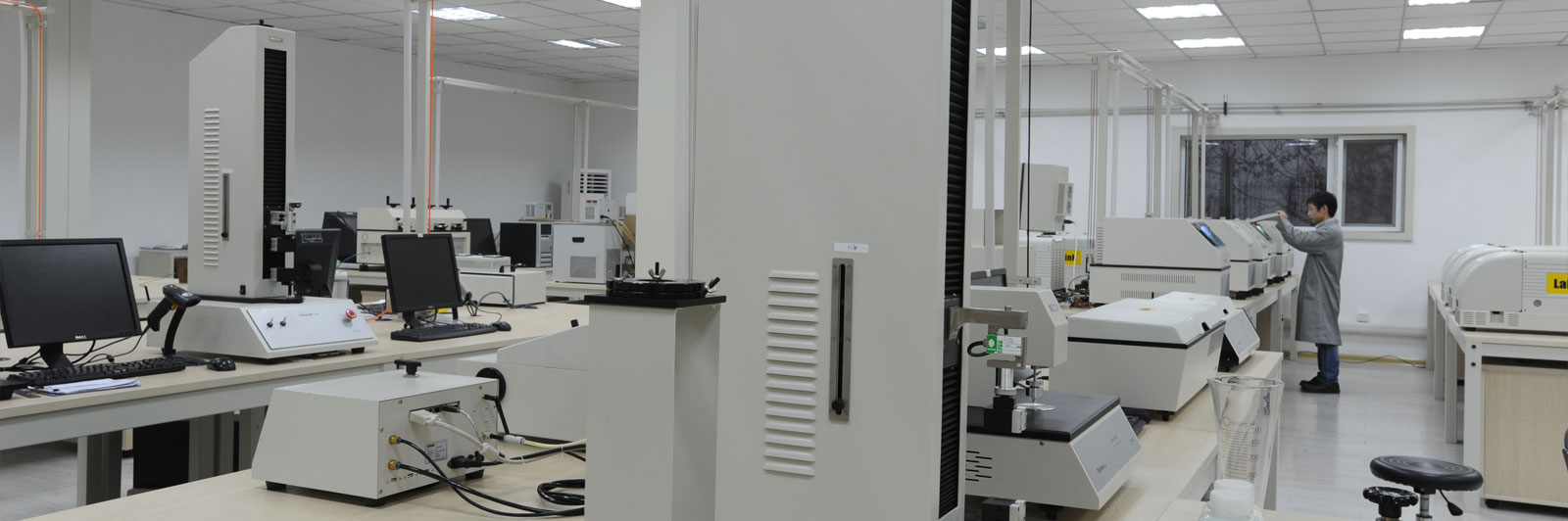
A tensile load is applied to the specimen using an XLW-H Intelligent Electronic Tensile Tester, causing it to tear at the right-angle notch. The maximum load recorded during the tearing process (the right-angle tear load) is used to calculate the material's right-angle tear strength. This method effectively evaluates the material's tear resistance at a stress concentration point (the right-angle notch).
II. Specimen Requirements
Specimen dimensions: (50 ± 1) mm × (27 ± 1) mm
Right-angle notch depth: (12 ± 0.5) mm
Specimens must be tested in both the machine direction (MD) and the transverse direction (TD).
At least 5 valid specimens per direction.
For ultra-thin materials (thickness < 20 μm), stacked specimen sets (3 sets, 5 layers per set) are permitted; however, it must be noted that the test results cannot be compared with those of single-layer specimens.
No cracks, scratches, or machining marks are permitted at the right-angle notch.
Specimens must be taken from areas away from package edges, heat seals, etc.
III. Test Environment and Equipment Requirements
Temperature: (23 ± 2) °C
Relative humidity: 50% ± 10%
Conditioning: Specimens must be conditioned in the standard environment for at least 4 hours.
XLW-500N Electronic Tensile Tester:
Complies with GB 1040 requirements
Tensile speed: 200 ± 20 mm/min
Force measurement accuracy: ±1%
Capacity: Select an appropriate range based on material properties (e.g., 500 N)
IV. Test Procedure
Cut the specimen according to standard requirements.
Measure the specimen thickness (average thickness at the right-angle notch).
Set the test speed to 200 ± 20 mm/min.
Calibrate the vertical alignment of the grips.
Clamp the specimen into the grips.
Ensure the clamping length is ≤ 22 mm and the direction of force application is vertical.
Start the testing machine and stretch the specimen until it tears.
Record the peak load during the tearing process.
Record the maximum tearing force (N).
Save the load-displacement curve.
Right-angle tear strength (kN/m) = Maximum tearing load (N) / Specimen thickness (mm)
Example: For a greenhouse film specimen with a thickness of 85.6 μm (0.0856 mm) and a maximum tearing load of 75 N, the right-angle tear strength is:75 N / 0.0856 mm = 875.9 kN/m
V. Advantages of the Link Testing XLW-500N Electronic Tensile Testing Machine
For more details please visit www.linktesting.org
Response within 24 hours · Factory-direct quotation · ASTM / ISO compliant