Source: Link Testing Instruments Co.,Ltd.
Inconsistent seal strength is one of the most elusive yet troublesome issues facing flexible packaging manufacturers. Many quality control professionals treat a "pass" on leak tests as a safeguard, only to face customer complaints regarding ruptured bags and leakage during transit. The root cause often lies not in the leak detection process itself, but in the sealing stage—specifically, a failure to achieve a secure seal. This article begins by explaining the adjustment logic of heat-sealing testers and clarifies how the three key parameters—temperature, pressure, and dwell time—affect seal strength.
I. Heat sealing: The "first step" in creating a seal
Flexible packaging relies on the heat-seal layer melting, bonding, and cooling/setting under the combined action of temperature, pressure, and time. Seal integrity testers check whether a "finished seal can withstand stress," whereas heat-seal testers check whether the seal was "securely formed in the first place"—the former evaluates the result, while the latter addresses the source. With PPWR driving trends toward thinner films and multi-layer structures, heat-seal windows have narrowed and process tolerances have decreased, further amplifying the importance of controlling the process at its source.
II. Temperature: Determines whether the heat-seal layer melts sufficiently
If the temperature is too low, the heat-seal layer does not melt completely; the two layers may touch but fail to bond, resulting in a "false seal" (or "tack seal") that looks intact but peels apart easily. Conversely, if the temperature is too high, the film may burn through, or the seal area may become thin, brittle, and prone to "undercutting" (weakening at the seal edge). Temperature is the most sensitive parameter and often the only one adjusted in many factories—yet adjusting temperature alone rarely yields a stable seal.
III. Pressure: Determines whether the layers make firm contact and air is fully expelled
Insufficient or uneven pressure leaves residual air between layers or results in areas of incomplete contact, leading to false seals, skewed seals, or unsealed spots. Multi-layer composite films and thicker materials, in particular, demand greater pressure uniformity. Higher pressure is not necessarily better; excessive pressure can squeeze out the melt and thin the seal area, actually weakening its strength.
IV. Time (Dwell time): Determines whether the melt cools and sets completely
If the dwell time is too short, heat transfer is insufficient and the seal fails to set properly, resulting in a brittle seal prone to cracking under subsequent stress; conversely, an excessively long time leads to "over-sealing," increasing energy consumption and risking burn-through. Time, temperature, and pressure are interdependent variables: a higher temperature allows for a shorter dwell time, and vice versa. It is impossible to determine the optimal processing window by considering any single parameter in isolation.
|
Defect Type |
Typical Appearance | Relevant Parameters |
| Weak Seal | Appears intact but tears open easily | Insufficient temperature / pressure |
| Over-sealing | Film thins or burns through | Excessive temperature / duration |
| Root Cutting | Clean break at the seal edge | Insufficient cooling / material embrittlement |
| Skewed Seal | Uneven sealing; unsealed areas | Uneven pressure / misalignment |
Scenario: After a food processing plant switched to a new composite film supplier, it continued using the temperature settings from the previous supplier. Consequently, the new film suffered from widespread "false sealing" (inadequate bond) under the old parameters, yet the issue went undetected during routine factory-exit inspections due to the nature of probability-based sampling. Subsequently, a heat-seal tester was used to determine the optimal parameter window, and the required seal strength was codified into a standard; this led to a significant reduction in customer complaints regarding package failures.
V. How a Heat Seal Tester Helps You Find the "Heat Seal Window"
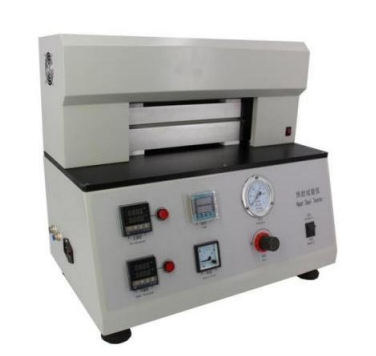
The value of the Link Testing’s heat seal tester lies not merely in its heating capability, but in its ability to independently and precisely set and replicate the combination of temperature, pressure, and time. This allows you to transform the optimal seal—previously achieved on the production line through trial-and-error experience—into a standardized process that is both reproducible and verifiable. A two-step approach is recommended:
① Process Development: Conduct parameter sweeps using a heat-seal tester to identify the optimal heat-sealing window—avoiding both incomplete seals and over-sealing—and establish this as the standard operating procedure for the workshop.
② Incoming Material Verification: Test samples from each batch of film using the heat-seal tester to confirm that seal strength meets specifications before releasing the material to the production line, thereby mitigating risks prior to production.
For more details please visit www.linktesting.org